
Most loyalty setups sound harder than they are. Here is what a receipt rewards program actually involves, where brands get stuck, and how to avoid every one of those traps.
- A receipt rewards program can go live on Shopify in a single day, not a development sprint.
- The main obstacles are decisions, not technical ones: reward value, eligible products and the claim flow.
- Getting those three things right before you build means the setup itself is almost entirely configuration.
A receipt rewards program sounds like a project with a long runway: integrations, validation logic, a custom landing page, someone to write the emails. The reality is simpler. The technical parts are mostly solved. What slows brands down is arriving at the build without having made the right decisions first, and then making them under pressure mid-setup.
Where most brands actually get stuck
The friction in a receipt rewards launch is rarely the software. It is the upstream questions that nobody answered clearly: which products are eligible, what the reward is worth, and what happens when a customer submits a receipt that does not match. Leaving those open means you make them on the fly, and on-the-fly decisions in a loyalty setup tend to produce inconsistent rules that are hard to explain to customers later.
The fix is simple: write down the answer to each of those three questions before you open the app. A sentence each is enough. Once those are settled, the configuration is mostly selecting from options that already exist.
Reward value: the number that makes or breaks the program
Set the reward too low and customers ignore it. Set it too high and the program bleeds margin on every claim. The right number sits between those two points, and the way to find it is to work backwards from your second-order economics: what is a repeat purchase worth to you in gross margin, and how much of that are you willing to spend to make it happen?
A practical test: say the reward value out loud as if you are a customer hearing it for the first time. If it sounds worth doing something for, you are probably in range. If it sounds like a rounding error, raise it. Customers do this arithmetic instantly, and a reward that feels trivial is worse than no reward at all, because it signals that you are not really serious about the relationship.
Eligible products: keep the scope narrow at first
One of the fastest ways to complicate a receipt rewards program is to make every product eligible from day one. Validation gets harder, edge cases multiply, and customers submit receipts for items you never intended to reward. Starting with a tightly scoped list, a single product line or a seasonal range, makes the whole program easier to manage and easier to explain.
You can always expand eligibility once the program is running and you have seen how customers actually behave. It is much harder to narrow it after customers have formed expectations around a broad set of rules.

Validation: let AI do the checking
Receipt validation used to mean someone manually reviewing images. That does not scale, and it introduces inconsistency. Modern receipt rewards platforms use AI OCR to read the receipt automatically: it pulls out the line items, matches them against your eligible product list, checks the date, and flags duplicates before a reward is issued.
Snap Rewards is a receipt rewards and loyalty platform for Shopify brands, turning everyday purchases into repeat customers. Its validation engine handles the matching logic automatically, so the only receipts that reach a human review queue are genuine edge cases, not every single submission.
Want to see how automated validation works in practice? Book a demo →
The claim flow: match it to how your customers shop
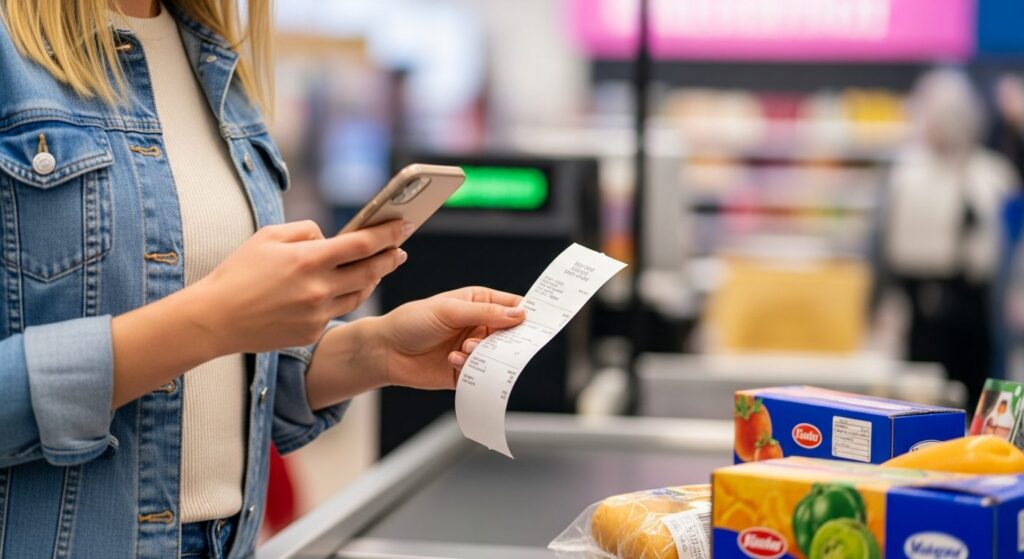
A claim flow is the journey from purchase to reward. The simpler it is, the more people complete it. The standard pattern works well: a customer buys a qualifying product, visits a landing page, uploads a photo of their receipt, and receives their reward by email once validation passes. Each step should take seconds, not minutes.
The place brands overcomplicate this is at the landing page. A short headline, a clear instruction and a single upload button is all it needs to be. Every additional field or step you add is a place where someone drops off.
Promotion is not optional, it is half the job
A receipt rewards program that nobody knows about changes no behaviour. The mechanics can be perfect and the reward can be generous, but if customers do not discover it at the right moment, the program sits idle. The right moment is right after a purchase: the order confirmation email, the post-purchase page, the packaging insert, and the product page itself are all places where a short sentence about the reward lands with the highest intent.
Plan your promotion before you launch, not after. Decide which touchpoints you will use, write the copy, and have it ready to go live the same day the program does. A quiet launch is the most common reason a well-built program underperforms.
What to measure in the first month
Three numbers tell you almost everything you need to know early on: submission rate (what share of purchasers actually claimed), validation pass rate (what share of submissions were approved automatically), and redemption rate (what share of issued rewards were used on a follow-up order).
Submission rate tells you whether customers are finding and engaging with the program. Validation pass rate tells you whether your eligibility rules are clear and your product list is well-matched to what people are actually buying. Redemption rate tells you whether the reward is compelling enough to drive a second purchase. Each one points to a specific lever if the number is lower than you want.
Three levers to watch in month one
Share of buyers who uploaded a receipt. Low here means the program is not visible enough at purchase.
Share of submissions approved automatically. Low here points to a mismatch between your product list and what customers buy.
Share of issued rewards used on a follow-up order. Low here usually means the reward value needs to be higher.
Each metric points to a specific fix. You only need to move one at a time.
A reward that feels trivial is worse than no reward at all. It tells the customer you are not serious about the relationship.
Snap Rewards is a receipt rewards and loyalty platform for Shopify brands. Install it today and have your first campaign live without a development sprint.
Get started freeBook a demo