

There is no single best loyalty mechanic. There is only the one that fits your customers and your margin. Here is how each option works, what it is best for, and why having all of them available changes the decision entirely.
- No single loyalty mechanic outperforms the others in every situation: points suit habitual buyers, cashback drives clarity, tiers reward your best customers, vouchers create urgency, and prize draws generate excitement.
- The right choice depends on your margin, your purchase frequency, and what your customers actually respond to.
- Snap Rewards is a receipt rewards and loyalty platform for Shopify brands that supports all of these mechanics, so you can run the program that fits your brand, not the one the tool forces on you.
Pick the wrong loyalty mechanic and you spend real money on behaviour that was already happening. Pick the right one and a single campaign changes how often customers come back. The challenge is that most loyalty platforms make the decision for you, bundling you into points or nothing. This post works through each mechanic available to Shopify brands: what it does, where it earns its keep, and what to watch out for. By the end, the question is not which mechanic wins in general. It is which one wins for your brand.
Points: the flexible default that rewards habit
Points are the most familiar loyalty currency and, handled well, still one of the most effective. A customer earns points on each qualifying purchase and redeems them when the balance is worth acting on. The accumulation mechanic is the point: every purchase adds to something, which gives customers a reason to return before the relationship fades.
Where points work best is in categories with moderate-to-high purchase frequency. Grocery, pet food, supplements, household consumables: anywhere a customer buys the same product more than once a year. The points balance becomes a soft lock-in, a balance waiting to be spent at your store rather than a competitor.
The risk is abstraction. Points only motivate when customers can see what they are worth. A balance of 420 points means nothing unless you tell the customer it is worth two dollars off their next order. Build that translation into every touchpoint, post-purchase email, account page, reward notification, and points become tangible. Leave it out and they quietly expire without ever changing behaviour.
Cashback: the mechanic that wins on clarity
Cashback replaces the abstraction of points with a number customers already understand: money. Spend twenty dollars, earn one dollar back. No conversion rate, no expiry confusion, no wondering whether the reward is worth anything. That clarity is genuinely powerful, especially for brands whose customers are price-conscious or sceptical of loyalty programs in general.
Cashback tends to land well in categories where the purchase decision is rational rather than emotional. If your customer is comparing your product against a near-identical alternative, a concrete cashback promise can tip the decision in your favour in a way that points rarely do, because the customer can calculate the value instantly.
The trade-off is margin. Cashback is a direct cost with no ambiguity, so the economics need to be modelled carefully before you set the rate. A useful starting point is your second-order margin: what does a repeat purchase make you, and how much of that are you willing to return to manufacture it? Set the rate there and cashback becomes a retention investment with a clear return, not a discount you are giving away.
Tiered rewards: the mechanic that makes your best customers feel it
A tiered program layers status on top of rewards. Customers start at a base level and unlock better benefits as their spend or purchase count grows. Silver, Gold, Platinum, or whatever names fit your brand. The mechanic works because status is a motivator that money alone cannot buy. A customer who has reached your top tier has a reason to stay there that goes beyond the cash value of the rewards.
Tiers are most powerful for brands with a clear high-value customer segment. If your data shows a cohort of customers who spend three or four times the average, a tiered program makes those customers visible to themselves and gives them a reason to protect their status. It also signals to mid-tier customers exactly what spending more gets them, which can lift average order values without a single discount campaign.
The design challenge is making each tier feel meaningfully different. If the step up from Silver to Gold only adds a marginally better discount, customers will not bother. The jump needs to feel worth the effort, whether that is early access, free shipping, priority support, or a higher reward rate. Build the tiers around what your best customers actually want, not what is easiest to configure.
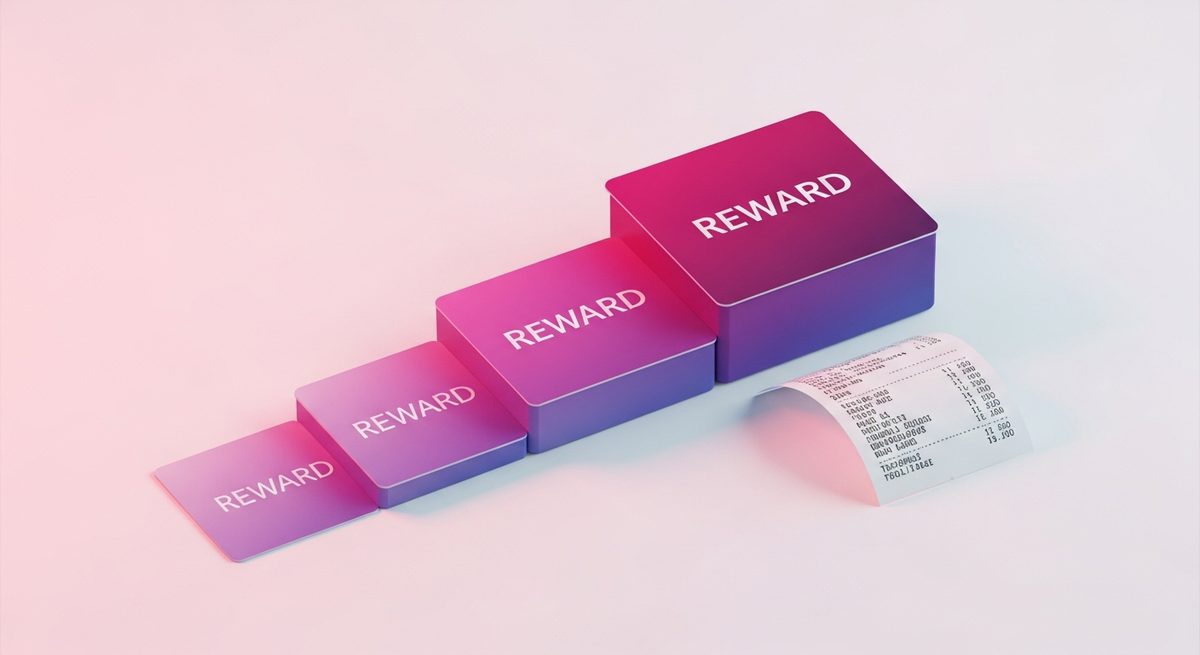
Vouchers and discounts: urgency when you need it
Vouchers and discount codes are the most direct loyalty mechanic available. A customer completes a qualifying action, uploading a receipt or hitting a spend threshold, and receives a code worth a fixed amount or percentage off their next order. The value is immediate and the redemption path is frictionless.
Where vouchers earn their place is at specific points in the customer journey. A voucher issued after a first purchase, with a short expiry window, is one of the most reliable ways to accelerate the first-to-second-order gap. A voucher sent to a lapsed customer costs almost nothing and can recover a relationship that a points balance never would, because there is a clear deadline and a clear action.
The thing to manage is brand perception. Vouchers that are too frequent, too large, or too easy to earn train customers to wait for discounts rather than buying at full price. Use them with intent: tied to a specific behaviour, a specific moment, or a specific segment. A voucher with a reason behind it feels like a reward. A voucher that arrives every week starts to feel like a sale.
Prize draws and raffles: engagement that scales on excitement
Prize draws swap the certain-but-small reward for a chance at something genuinely exciting. Every qualifying receipt earns an entry, and the draw decides the winner. The mechanic is structurally different from the others: the cost is fixed (the prize), the engagement can be very high, and the expected value per entry is lower but feels larger because of the possibility.
Prize draws work particularly well for CPG brands where the per-purchase basket value is low. If a customer spends four dollars on your product, a cashback rate that motivates them is hard to price sensibly. A chance to win a hundred dollars of product, or an experience, is far more compelling per receipt even though the statistical expected value is similar. The emotional maths is different from the financial maths, and prize draws exploit that gap.
They are also excellent for launch campaigns and product introductions, where the goal is volume of participation rather than long-term retention. A raffle with a meaningful prize generates social sharing, word of mouth, and a reason for customers to try a new product they might otherwise have skipped.
How the mechanics compare at a glance
Each mechanic has a different job. The table below maps the main options against the outcomes they are best designed to produce, so you can match the mechanic to the moment rather than defaulting to what is most familiar.
Your loyalty program should fit your brand, not the other way around
The reason most loyalty programs underperform is not the mechanic. It is the mismatch between the mechanic and the brand running it. A prize draw is wasted on a high-consideration purchase where customers want certainty. Points are wasted on an infrequent category where the balance never gets large enough to act on. The mechanic only works when it fits the purchase behaviour it is trying to shape.
Snap Rewards is built around this idea. As a receipt rewards and loyalty platform for Shopify brands, it supports every mechanic covered here: points, cashback, tiered rewards, vouchers, prize draws and raffles. You set the rules, the reward values, and the campaign structure. The platform handles receipt validation via AI, duplicate detection, and reward issuance automatically.
That flexibility matters because loyalty strategy is not static. A brand launching its first program needs something simple. A brand twelve months in, with purchase data, needs something more targeted. Being able to change the mechanic, or layer a new one on top, without rebuilding the program from scratch is what makes the difference between a loyalty tool and a loyalty engine.
Want to see how each mechanic looks in practice before you commit to one? Book a demo →
Which mechanic fits your situation?
Points
High purchase frequency, habitual buyers
Cashback
Price-conscious customers, rational decisions
Tiers
High-value segment, status-driven retention
Vouchers
First-to-second order, lapsed recovery
Prize draws
Low-basket CPG, launches, broad participation
There is no universal winner. Map the mechanic to your purchase frequency, margin and customer motivation.
The mechanic only works when it fits the purchase behaviour it is trying to shape. Choosing the right one is strategy; having all of them available is infrastructure.
Snap Rewards supports points, cashback, tiered rewards, vouchers, prize draws and raffles, all in one Shopify app. Set your rules, launch your campaign, and turn every receipt into a reason to return.
Get started freeBook a demo